

ST’s battery-management IC ensures longer-lasting lithium power in portable equipment
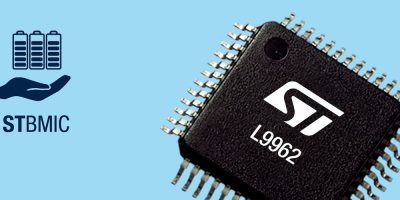
STMicroelectronics’ L9962 lithium-battery management IC delivers precision by integrating a 12-bit analog-digital converter (ADC), coupled with generous cell-balancing current of 70mA, to ensure rapid voltage correction for improved battery health.
Designed for lithium-ion (Li-ion) and lithium-polymer (Li-Po) battery packs with up to 10 series-connected cells, the L9962 provides monitoring, balancing, and protection to optimise performance and enhance safety and stability. It is suitable for cordless power tools and other portable and semi-portable equipment, including medical devices, light electric vehicles like e-bikes and scooters, and backup energy storage such as UPS. Its ultra-low quiescent current maximises runtime and permits power-saving modes including 5µA standby and 2µA deep-sleep for products in transit.
The L9962 measures individual cell voltages on a continuous cycle with programmable loop time and activates balancing and cell protection upon detecting over-voltage or under-voltage. In addition, plausibility checking compares the total stack voltage with the number of cells. While ensuring cell voltages remain tightly aligned, the L9962 maintains voltage-measurement accuracy across the full operating-temperature range.
By integrating a high-accuracy current-sense amplifier for stack-current measurement using Coulomb counting, the L9962 detects excessive charge and discharge currents and provides short-circuit discharge protection. Easily calibrated with a single point on the production line, the L9962 maintains 0.25% current-measurement accuracy over the full temperature range. Thermal monitoring with an NTC thermistor provides accurate ratiometric measurements to detect battery-pack over-temperature and under-temperature.
Additional integrated features add value and save external circuitry, including battery-pack fuse management and configurable high-side/low-side pre-drivers for battery-pack relays. There is also a 3.3V low-dropout regulator (LDO), which remains turned on in standby mode, to provide power for external components such as a microcontroller or indicator LEDs. An I2C interface lets the host system configure device parameters such as the voltage-measurement interval and read back information such as battery state-of-charge (SOC) and state-of-health (SOH).